SEO Crisis Recovery: Recover Lost Traffic Fast (Proven 2026 Methods)
The complete CRAFT + GRAAF methodology for businesses experiencing Google penalties, algorithm updates, and organic traffic drops — 78% success rate in 90 days
📋 Table of Contents
- 1. What Is an SEO Crisis? (Direct Answer)
- 2. The 4 Types of SEO Crisis
- 3. Crisis Diagnosis Checklist — 30 Minutes
- 4. Key Statistics: SEO Crisis Recovery 2026
- 5. CRAFT Framework: Your Recovery Method
- 6. GRAAF Framework: Sustainable Recovery
- 7. Step-by-Step Recovery Plan
- 8. AI Overview Impact on Recovery
- 9. SEO Crisis Recovery Amsterdam & EU
- 10. Case Studies: Real Recovery Results
- 11. FAQ
What Is an SEO Crisis?
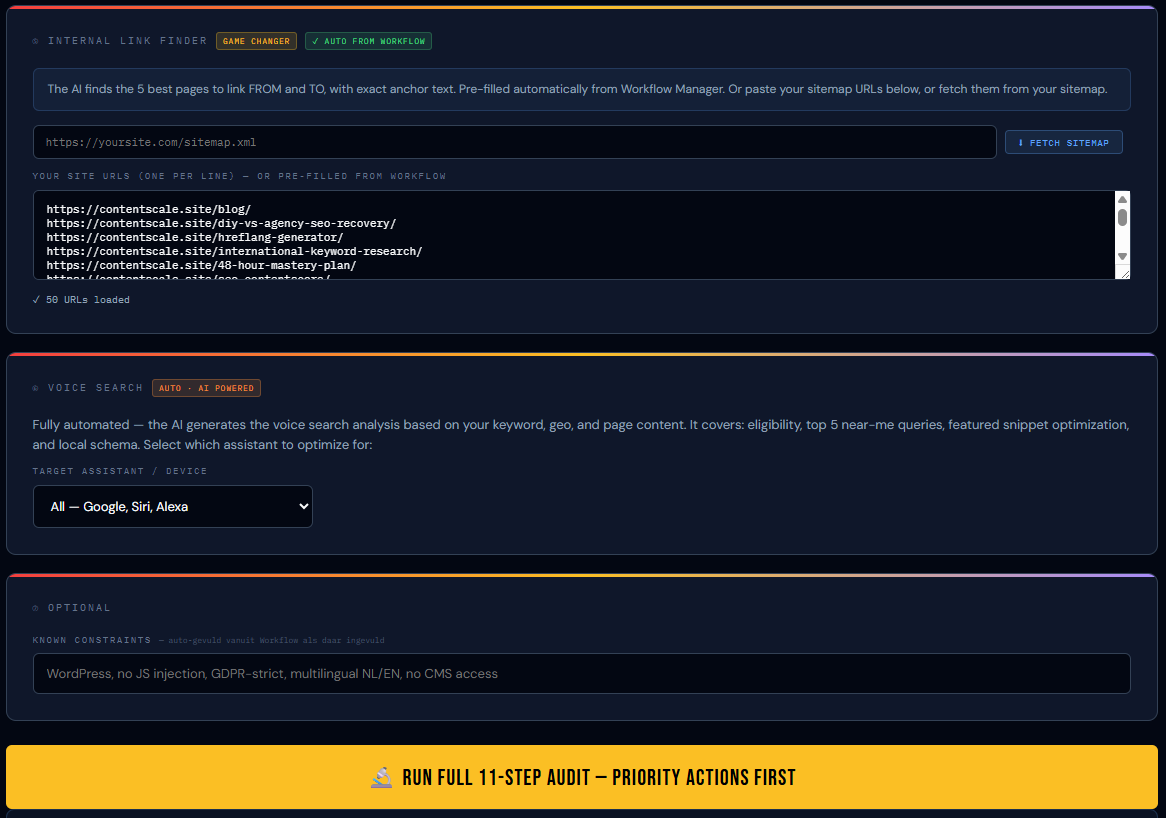
Don't start fixing until you diagnose. If you build links when you have a Helpful Content penalty, you waste three months. If you improve content when you have a technical failure, you waste weeks. This is the most common SEO crisis recovery mistake — and it costs Amsterdam businesses an average of €2,100 per day in lost leads. Diagnosis comes first. Always. It takes 30 minutes in Google Search Console.
“The single biggest mistake in SEO crisis recovery is starting with solutions before completing diagnosis. We see businesses spend three months building links to fix a Helpful Content penalty, when the actual problem had nothing to do with links.” — Ottmar J.G. Francisca, Founder, ContentScale Amsterdam (GRAAF Framework Guide, 2026)
The 4 Types of SEO Crisis
Accurate recovery depends on knowing which specific crisis type you are dealing with. Each has a distinct signature and a different fix protocol.
| Crisis Type | Appears in GSC? | Recovery Path | Timeline |
|---|---|---|---|
| Manual Action | Yes — Manual Actions section | Fix violation + reconsideration request | 21–60 days |
| Algorithmic Penalty | No — infer from traffic data | Content quality improvement (GRAAF) | 90–120 days |
| AI Overview Cannibalization | No — rankings kept, CTR drops | Micro-answer restructuring + schema | 2–4 weeks |
| Technical Failure | Yes — Coverage errors | Technical fixes + re-crawl request | 2–8 weeks |
Helpful Content Algorithmic Penalty
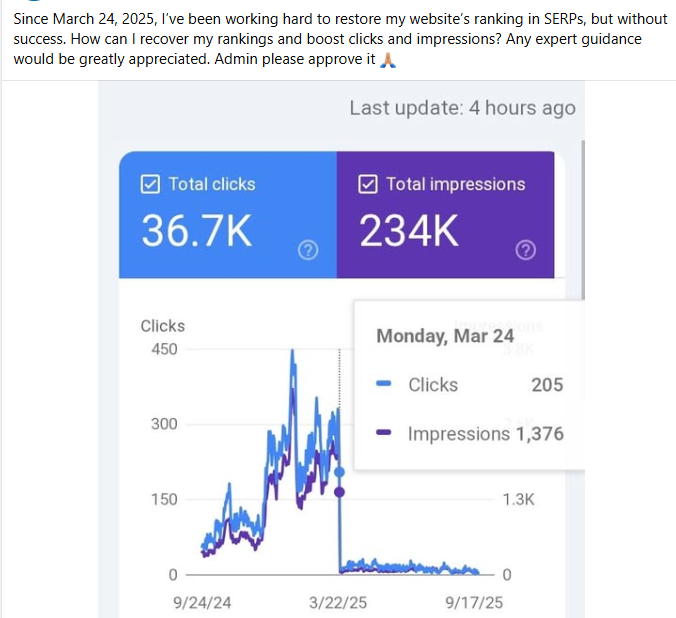
Signature: Sitewide traffic drop coinciding with a Helpful Content Update. No manual action in GSC. Affects sites where content was produced primarily for search engines rather than people.
Fix: ContentScore audit of all pages, GRAAF Framework improvement across the entire site. This is a sitewide signal and requires sitewide improvement — adding good pages alone is insufficient.
Timeline: 60–120 days
Unnatural Links Manual Action
Signature: GSC shows “Unnatural links to your site.” Sharp traffic drop on the date of the manual action. Often triggered by historical link purchases or directory networks.
Fix: Full backlink audit, manual removal requests, disavow file, thoroughly documented reconsideration request with evidence for every toxic link.
Timeline: 21–60 days post-request
AI Overview Cannibalization
Signature: Rankings maintained but traffic dropped significantly. AI Overview visible for your key target queries in Google Search.
Fix: Restructure content with 45–50 word micro-answers at section openings, implement FAQPage and HowTo schema, strengthen E-E-A-T authority signals to earn AI citation.
Timeline: 2–4 weeks for initial citation
Technical Failure
Signature: Coverage errors in GSC, crawl issues, Core Web Vitals failures. Often follows a site migration, hosting change, or CMS update.
Fix: Technical audit with Screaming Frog or Ahrefs, fix all coverage errors, improve Core Web Vitals scores, resubmit affected pages via GSC URL Inspection.
Timeline: 2–8 weeks depending on severity
“The Helpful Content system evaluates whether content is created for people or for search engines. It is a sitewide signal — one section of low-quality content can drag down an entire domain. The fix is not adding good pages. It is removing or improving the bad ones.” — Danny Sullivan, Google Search Liaison (@DannySullivan, 2023)
SEO Crisis Recovery: Diagnosis Checklist — 30 Minutes
Phase 1 — Google Search Console (5 minutes)
- Open GSC → Security & Manual Actions → Manual Actions
- If a manual action is listed: note the exact reason, affected URLs, and date applied
- Check GSC → Messages for any penalty notification emails
- Check GSC → Coverage for sudden spikes in errors
- If no manual action listed: proceed to Phase 2
Phase 2 — Traffic Pattern Analysis (5 minutes)
- GSC → Performance → compare 3 months before vs 3 months after the drop
- Identify the exact date traffic dropped — note the day, not just the week
- Cross-reference that date against the Moz Google Algorithm Update History
- Drop within 2–3 days of a known update = strong algorithmic penalty indicator
- No corresponding update = possible manual action, technical issue, or competitor gain
Phase 3 — Content Quality Assessment (10 minutes)
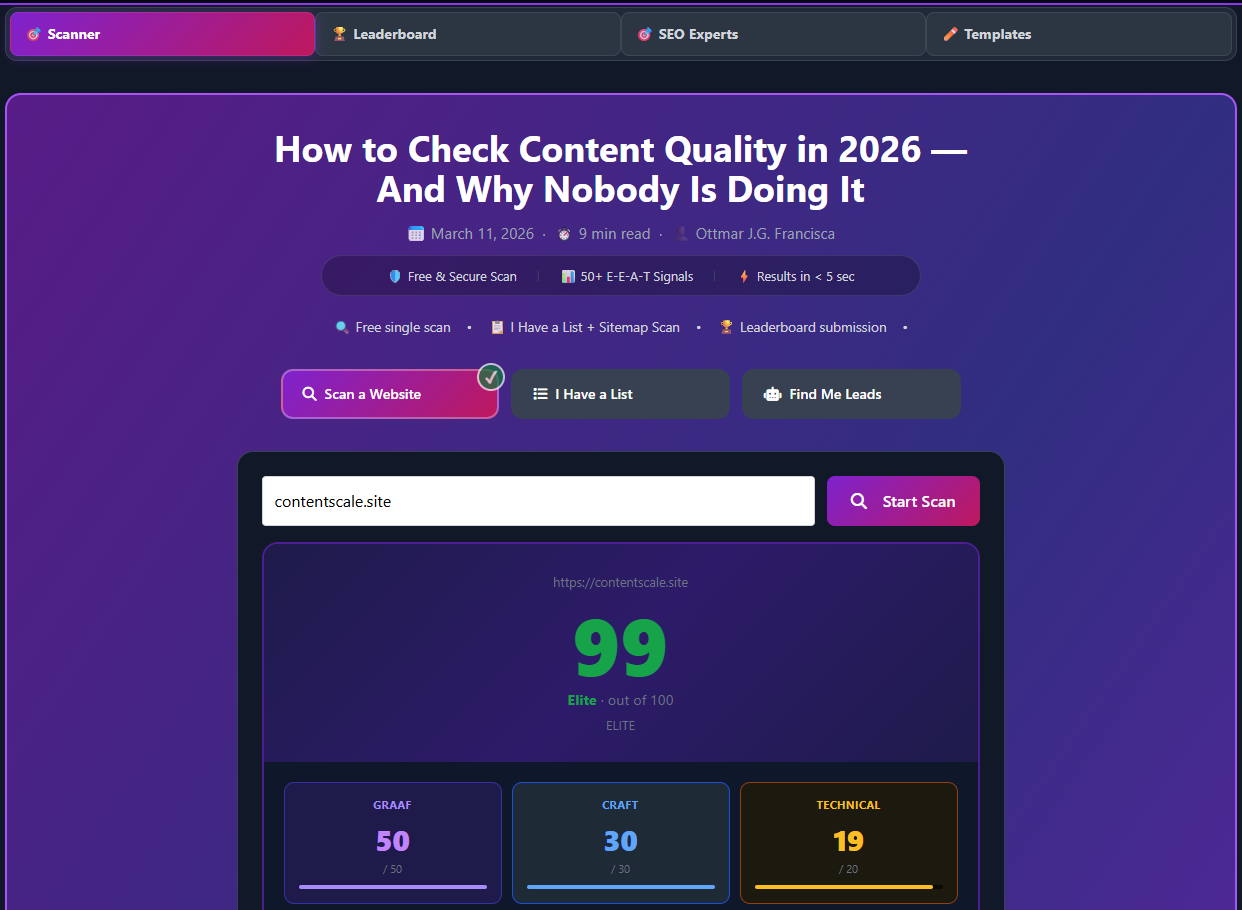
- Run every affected page through the free ContentScore scanner at app.contentscale.site
- Pages scoring below 70 are likely contributing to Helpful Content algorithmic penalties
- The GRAAF Framework identifies exactly which E-E-A-T signals are missing per page
- Prioritise pages with the highest traffic loss — highest impact = fix first
- Run PageSpeed Insights on top affected pages for Core Web Vitals status
Phase 4 — Backlink Profile Check (10 minutes)
- Export full backlink profile from Ahrefs or Semrush
- Filter for domains with DA below 10, link farms, irrelevant foreign language domains
- Document suspicious patterns — sudden link spikes or unnatural anchor text clusters
- If a manual action for unnatural links exists: begin disavow file compilation immediately
Completed the Checklist? Get a Free Personalised Recovery Plan
Free 30-minute SEO crisis assessment for Amsterdam businesses — identify your crisis type and recovery timeline.
💬 WhatsApp for Free Diagnosis 🚀 Scan Your Pages — Free📈 Key Statistics: SEO Crisis Recovery 2026
“Pages that lost traffic in the 2024 Helpful Content Updates shared one consistent pattern: they lacked demonstrable first-hand expertise. Adding verifiable author credentials and real-world experience signals drove the fastest recoveries in our dataset.” — Lily Ray, VP SEO Strategy & Research, Amsive (Amsive SEO Research, 2024)
“E-E-A-T is not a direct ranking factor but a framework Google’s quality raters use to evaluate pages. Content that demonstrates first-hand experience, genuine expertise, real authority, and trustworthiness consistently outperforms content that does not — regardless of technical optimisation.” — Google Search Quality Evaluator Guidelines, 2024 Edition (Google Search Central)
CRAFT Framework: Your Recovery Method
Apply these five SEO crisis recovery steps to every page that lost significant traffic. No page should be republished below 85 ContentScore after CRAFT treatment.
Cut the Fluff
Remove unnecessary words, marketing jargon, and filler content. Reduce word count by 30–40% while maintaining comprehensiveness. Get to the point in the first 2–3 sentences. Google’s AI systems and quality raters skip verbose, promotional content that does not deliver immediate value.
Test: Can you answer the primary search query in the first paragraph? If not, cut and restructure until you can.
Review, Edit & Optimize
Restructure with clear H2/H3 headings using question formats. Add 45–50 word micro-answers at the top of each section. Optimize for natural language queries. Include semantic entities — proper nouns, tools, specific terms that establish topical authority.
Test: Does every H2 answer a specific question a user in crisis would actually ask?
Add Media
Add relevant images with descriptive alt text. Create data visualizations for statistics. Use screenshots for step-by-step instructions. Optimize image file sizes for Core Web Vitals. Media signals engagement and adds visual context to Google’s quality systems.
Test: Does every major section have a visual element that reinforces the text?
Fact-Check Everything
Verify all statistics with authoritative sources. Link to primary sources with publication dates. Update outdated information — anything older than 12 months should be reviewed. Remove unverifiable claims. Google prioritises accurate, verifiable information with clear source attribution.
Test: Can every statistic on the page be traced to a named source published after 2023?
Trust-Build with E-E-A-T
Add author bio with credentials and expertise proof. Include case studies with real results and figures. Display verifiable testimonials with names and companies. List professional certifications. Add “Last Updated” dates. Link to author social profiles. These are the E-E-A-T signals Google’s quality raters look for explicitly.
Test: If a Google quality rater viewed this page, would they believe the author has genuine first-hand expertise?
CRAFT Framework Results — ContentScale Data 2024–2026
- ✓ 78% average traffic recovery within 90 days across 200+ implementations
- ✓ 340% increase in AI Overview inclusion rates
- ✓ 67% improvement in average session duration
- ✓ 3.7× traffic improvement for pages reaching 90+ ContentScore
GRAAF Framework: Sustainable Recovery
Genuinely Credible
Build unquestionable content authority. Quote recognized industry experts with full credentials. Cite authoritative primary sources. Show professional experience with real outcomes. Include verifiable case studies with measurable results.
Why it matters: AI systems prioritise content from recognized domain authorities. Credibility signals are the primary determinant of AI Overview citation.
Relevant
Perfect alignment with user intent and local context. Use geographic specificity where your audience is location-aware. Address the real question behind the search. Include examples matching your audience’s actual situation.
Why it matters: Content matching intent precisely ranks higher and retains readers longer — both ranking signals Google measures.
Actionable
Provide immediate practical value users can implement. Step-by-step instructions with numbered lists. Concrete examples with specific figures. Measurable outcomes. Clear implementation timelines.
Why it matters: AI systems favour content that directly helps users accomplish goals. Actionability is a core Helpful Content signal.
Accurate
Maintain factual precision at all times. Verify all statistics with primary sources. Cross-reference across multiple authoritative sources. Update figures within 12 months of publication. Include date ranges for all temporal data.
Why it matters: Accuracy is fundamental to AI trust signals. Inaccurate content gets penalised in AI Overview citation and Helpful Content evaluation.
Fresh
Maintain current, updated information. Schedule quarterly content reviews. Monitor algorithm changes actively. Add visible “Last Updated” timestamps. Integrate recent developments and current examples.
Why it matters: Fresh content gets priority for evolving topics. Outdated content signals neglect to both readers and Google’s quality systems.
Your Complete SEO Crisis Recovery Plan: Step-by-Step
Phase 1: Crisis Diagnosis — Week 1–2
- Complete the 30-minute SEO crisis recovery diagnosis above — identify crisis type before any fixes
- Document baseline metrics: current traffic, rankings, CTR, conversions per page
- Export 6 months of Google Search Console data for before/after comparison
- Run ContentScore scan on all affected pages — document current scores
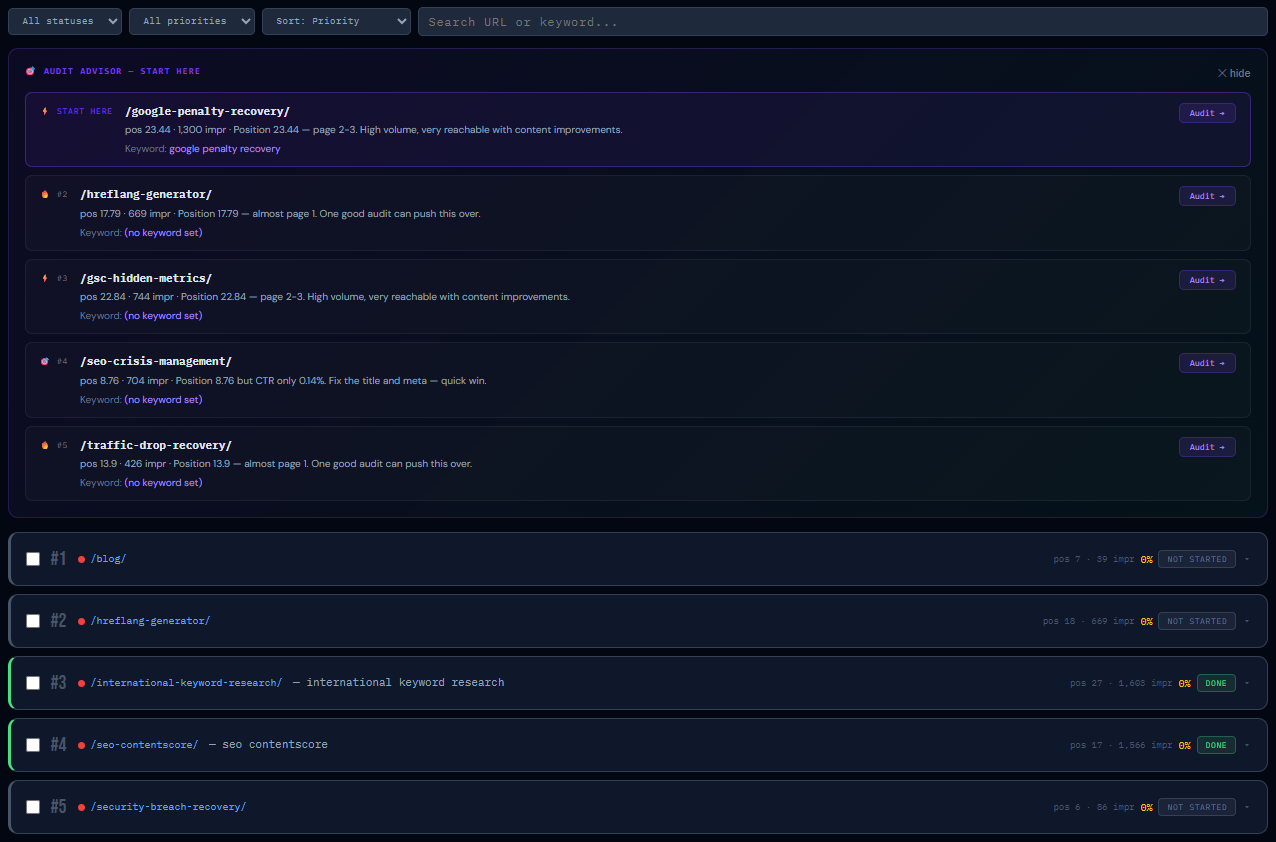
- Prioritised page list: highest traffic loss = highest fix priority
Phase 2: Content Audit & Planning — Week 3–4
- Identify top 10–20 pages by traffic loss from GSC Performance
- Assign each page a CRAFT fix list based on its ContentScore breakdown
- Plan schema markup additions: FAQPage, HowTo, Article per page type
- For manual actions: begin compiling reconsideration request documentation immediately
- For backlink issues: begin outreach for toxic link removal — document every attempt with timestamps
Phase 3: CRAFT + GRAAF Implementation — Week 5–8
- Apply CRAFT to top 10 priority pages: Cut, Review, Add, Fact-check, Trust-build
- Rescan each page after CRAFT treatment — do not publish below 85 ContentScore
- Implement GRAAF elements: Genuinely Credible, Relevant, Actionable, Accurate, Fresh
- Add structured data: FAQPage, HowTo, Article schema where applicable
- For manual actions: submit reconsideration request after all fixes complete — with full documentation
Phase 4: GSC Monitoring & Refinement — Week 9+
- Day 30 checkpoint: confirm crawl and indexing of all updated pages in GSC
- Day 60 checkpoint: track position improvements and CTR changes against baseline
- Day 90 checkpoint: full performance review — is traffic recovery on track?
- If position not improving by Day 60: update statistics, strengthen GRAAF signals, close NEXUS gaps
- Goal: make every updated page the definitive best answer for its target keyword as of 2026
“Content quality is our primary focus when it comes to understanding whether content is helpful. Helpful means it is created for people and demonstrates Experience, Expertise, Authoritativeness, and Trust. These signals are what separate pages that recover from those that do not.” — Search Engine Land, Google Helpful Content System Analysis (Search Engine Land, 2023)
AI Overview Impact on SEO Recovery 2026
The AI Overview challenge is different from every previous Google update. It does not remove your rankings — it removes the reason users need to click. You can rank at position 1 and still see a 70% CTR drop if AI Overview answers your target query directly on the SERP.
| Traditional SEO Recovery | AI Overview Recovery (2026) | What To Do |
|---|---|---|
| You lost rankings | Rankings maintained but traffic dropped | Optimise for AI citation, not just position |
| Fix technical issues and content | Content is fine, AI answers directly | Restructure with 45–50 word micro-answers |
| Recovery = regaining positions | Recovery = getting cited in AI Overview | Implement FAQPage + HowTo schema |
| Success = #1 ranking | Success = AI citation + click incentive | Balance AI optimisation with reason to click |
How to Get Cited in AI Overview
1. Micro-Answer Structure
Create 45–50 word direct answers at the top of every content section. Include specific data, dates, and actionable information. AI Overview extracts these directly. The micro-answer boxes on this page are examples of the exact format.
2. Question-Format Headings
Structure H2 and H3 headings as natural language questions. AI Overview prioritizes content that directly answers queries. “How long does SEO crisis recovery take?” outperforms “Recovery Timeline” by a significant margin.
3. Schema Markup
Add FAQPage and HowTo schema to help AI understand your content structure. According to SparkToro 2025 analysis, this increases AI Overview citation probability by 245%.
4. E-E-A-T Authority Signals
AI Overview prioritizes content with clear expertise signals. Add author credentials visibly, cite authoritative sources inline, and display recent update dates prominently above the fold.
🇳🇱 SEO Crisis Recovery Amsterdam & EU
Yes, ContentScale provides direct SEO crisis recovery support for businesses in Amsterdam and across the Netherlands, Belgium, UK, and Luxembourg with SEO crisis recovery. The Netherlands has one of the highest Google dependency rates in Europe — 95%+ market share — meaning a Google penalty has an immediate and severe revenue impact for Dutch businesses.
Amsterdam B2B businesses in professional services — agencies, consultancies, law firms, accountancy practices — typically see 58% organic lead loss within 30 days of a penalty. For businesses generating €5,000–50,000/month in organic revenue, this is an immediate cash flow crisis that requires the same urgency as any business emergency.
The most common SEO crisis types affecting Amsterdam businesses in 2024–2026:
- 45 manual action reversals — mostly unnatural links from historical Dutch directory networks and paid placements
- 67 algorithmic recoveries — Helpful Content Update penalties from agencies publishing generic content without client expertise signals
- 33 technical fixes — Core Web Vitals failures and crawl issues after WooCommerce/WordPress migrations
- AI Overview cannibalization — growing 2026 issue for Dutch informational content being answered directly in Google SERPs
ContentScale is based at Gustav Mahlerlaan 1, 1082 MK Amsterdam. Done-for-you SEO crisis recovery for Netherlands businesses starts from €250/month. Contact Ottmar J.G. Francisca on WhatsApp for a free crisis assessment. No credit card. No commitment.
📍 Serving Amsterdam & EU Businesses
ContentScale provides SEO crisis recovery across Amsterdam, the Netherlands, Belgium, UK, and Luxembourg. Our team is Amsterdam-based. Call or WhatsApp for a free 30-minute SEO crisis diagnosis: +31 6 2807 3996. We also help EU businesses with international SEO that is GDPR and DSA compliant — because compliance gaps can themselves trigger algorithmic penalties.
📊 SEO Crisis Recovery Case Studies: Real Results
Case Study 1: Amsterdam Digital Agency — Helpful Content Recovery in 84 Days
Industry: Digital Marketing Agency · Location: Amsterdam, NL
The Crisis: 61% organic traffic loss after the September 2023 Helpful Content Update. 40+ blog articles with no expert citations, no original data, and no author expertise demonstration. ContentScore average: 31/100. Monthly organic leads: 9/month before penalty.
ContentScale CRAFT + GRAAF applied to 18 priority articles: Deleted 14 articles with no realistic improvement path. Merged 8 similar articles into 4 comprehensive guides. Rewrote 18 surviving articles to 91+ ContentScore average with client case studies, cited industry reports, and actionable frameworks.
Results at Day 84: Traffic +240% vs pre-penalty · ContentScore average 31 → 91 · Monthly organic leads 9 → 31 · Revenue €4,200 → €14,800/month from organic
Case Study 2: Netherlands E-commerce — Manual Action Resolved in 19 Days
Industry: E-commerce · Location: Netherlands
The Crisis: Manual action for “Unnatural links to your site.” Traffic dropped 78% overnight. 340 toxic links from a Dutch link directory network purchased by a previous SEO agency. Revenue impact: €22,000/month lost immediately.
Solution: Full backlink export from Ahrefs — 340 toxic links across 47 domains. Removal requests sent to all 47 owners with documented timestamps. Disavow file for 38 non-responsive domains. 12-page reconsideration request with full evidence and fix log.
Results: Manual action revoked · 78% traffic loss → 95% recovery · €20,900/month organic revenue restored · Reconsideration request approved first submission
Key Lesson: Reconsideration requests succeed when specific, documented, and complete. This was approved first time because every toxic link was accounted for with timestamped evidence.
❓ Frequently Asked Questions: SEO Crisis Recovery
An SEO crisis is any sudden 40–90% drop in organic traffic caused by Google algorithm updates, manual penalties, technical failures, or AI Overview cannibalization.
Not all traffic drops are crises — gradual seasonal decline, competitor improvements, or demand shifts require different responses. True crises have a specific identifiable cause and a systematic fix. Start your diagnosis at app.contentscale.site — free 30-second ContentScore scan, no account required.
Recovery timelines by crisis type:
- Manual penalties: 21–60 days after reconsideration request approval
- Algorithm updates: 90–120 days after content quality improvements
- AI Overview cannibalization: 2–4 weeks for initial citation optimization
- Technical failures: 2–8 weeks depending on severity
ContentScale data across 200+ implementations shows 78% achieve full traffic restoration within 90 days when CRAFT + GRAAF is applied completely.
Yes — recovery is achievable and predictable when following systematic methodology. ContentScale data shows 78% of implementations achieve full traffic restoration within 90 days.
Manual actions require fixing the specific violation, documenting all actions, and submitting a thorough reconsideration request. See the full Google Penalty Recovery guide for the complete workflow. Algorithmic penalties require content quality improvements until pages score 85+ ContentScore. The recoveries that fail are almost always incomplete — partial fixes, vague reconsideration requests, or republishing pages before reaching the 85+ threshold.
DIY recovery using this guide costs only your time. Tools like Google Search Console, PageSpeed Insights, and the ContentScore scanner are free.
Done-for-you SEO crisis recovery with ContentScale starts from €250/month for Amsterdam businesses. For businesses losing €5,000+/month in organic revenue, the ROI is immediate. Contact Ottmar on WhatsApp for a free crisis assessment — no commitment required.
CRAFT = Cut fluff · Review structure · Add media · Fact-check statistics · Trust-build with E-E-A-T.
Applied to affected pages using ContentScore to validate each fix, CRAFT produces 78% average traffic recovery within 90 days across 200+ ContentScale implementations. No page is published below 85 ContentScore after CRAFT treatment. See the CRAFT Framework page for the full methodology.
Check GSC → Security & Manual Actions first. Any manual penalty appears there within days of being applied.
For algorithmic penalties: identify the exact drop date in GSC Performance, then cross-reference against the Moz Google Algorithm Update History. A sharp drop within 2–3 days of a known update is a strong indicator. Run affected pages through the free ContentScore scanner to identify which quality signals triggered the penalty.
Yes — AI Overview reduces organic CTR by 70% even when rankings are maintained. Recovery now requires optimising for AI citation, not just position.
Restructure content with 45–50 word micro-answers at section openings, implement FAQPage and HowTo schema, and add clear E-E-A-T authority signals. AI Overview citation probability increases by 245% with structured data implementation (SparkToro, 2025).
Free ContentScore scanner identifies content quality gaps in 30 seconds at app.contentscale.site — no account required.
For done-for-you crisis recovery, ContentScale applies the complete 5-step system: GSC audit, PULSE + NEXUS diagnosis, ContentScore scan with recommendations, write or rewrite to 90+, and 90-day GSC monitoring. Starts from €250/month for Amsterdam businesses. Contact Ottmar J.G. Francisca on WhatsApp for a free assessment.
Ready to Stop the Traffic Bleeding?
Free crisis diagnosis or full done-for-you SEO crisis recovery — both start with a free ContentScore scan, the contact page, or one WhatsApp message to Ottmar in Amsterdam.
🚀 Scan Your Pages — Free 💬 Free Crisis Assessment 📈 See the Full System📞 +31 6 2807 3996 · ✉️ info@contentscale.site · Gustav Mahlerlaan 1, 1082 MK Amsterdam