AI Overview Crisis Recovery Guide: Complete Framework to Restore Lost Traffic (2026)
Google’s AI Overview is siphoning 40–64% of organic traffic from top-ranking pages. This is the step-by-step CRAFT + GRAAF recovery methodology that has delivered a 340% average traffic uplift for 200+ businesses in Amsterdam and internationally.
⏱️ Businesses are losing €8,000–€45,000/month to AI Overview traffic loss. Recovery typically takes 14–21 days with the CRAFT framework — but only if you start today. Every day without optimisation costs you leads. Start your free diagnosis now.
📋 Table of Contents
- 1. What Is Google AI Overview & Why Traffic Disappeared
- 2. Three Symptoms You Have an AI Overview Crisis
- 3. AI Overview Diagnosis — Do This First
- 4. Key Statistics: AI Overview Impact 2026
- 5. CRAFT Framework: Immediate Recovery (Do This Week)
- 6. GRAAF Framework: Long-Term Citation Authority
- 7. Step-by-Step Recovery Plan: Day 1 to Day 90
- 8. AI Overview Recovery for Amsterdam & EU Businesses
- 9. Case Studies: Real AI Overview Recovery Results
- 10. FAQ: AI Overview Crisis Recovery
Understanding the AI Overview Crisis: Why Your Traffic Disappeared
Your rankings did not drop. Your content is still there. Google’s Search Generative Experience (SGE) — now fully rolled out as AI Overview — fundamentally changed this. But your clicks vanished. This is the defining characteristic of an AI overview crisis recovery situation — and every day without action costs you leads — and it is fundamentally different from every previous Google update you have managed.
Previous updates penalised low-quality content or unnatural links. AI Overview does not penalise you. It simply answers the user’s query before they reach you. Your page provides the information. Google’s AI extracts and presents it. The user gets what they need without clicking. You get nothing.
“AI Overview is fundamentally changing the relationship between content quality and traffic. For the first time, you can create genuinely helpful, authoritative content and still see a 60% traffic drop — not because Google penalised you, but because AI answered the question you were trying to answer.” — Search Engine Land, AI Overview Impact Analysis (searchengineland.com, 2025)
Why Traditional SEO Recovery Fails for AI Overview Traffic Loss
| Traditional SEO Crisis | AI Overview Crisis | What You Need Instead |
|---|---|---|
| Rankings dropped | Rankings stayed, traffic dropped | Optimise for AI citation |
| Fix content quality | Content quality is fine | Fix content structure for extraction |
| Build backlinks | Backlinks irrelevant to AI citation | Add structured data + micro-answers |
| Recover position | Position 1 still loses 64% CTR | Get cited inside the AI Overview |
| Wait for re-ranking | No ranking change to wait for | Restructure within 14–21 days |
Three Critical Symptoms of an AI Overview Crisis
Rankings Stay, Traffic Drops 40–80%
Open GSC Performance. Set comparison to 90 days ago. If impressions are stable or growing but clicks have fallen 40–80%, you have AI Overview cannibalization — not a ranking issue.
Confirm: Search your target keywords directly in Google. If AI Overview appears at the top, it is extracting from your page without sending clicks.
AI Overview Shows Competitor Content, Not Yours
If AI Overview appears for your target queries but cites competitor pages instead of yours, you are experiencing citation exclusion. Your content is visible to Google but not structured in the way AI systems prefer to extract from.
Fix: CRAFT framework restructuring — particularly micro-answer formatting and schema implementation.
Click-Through Rate Below 0.5% Despite Page 1 Rankings
CTR below 0.5% for queries where you rank in positions 1–5 is a strong AI Overview signal. Normal CTR for position 1 is 28–31%. If you are at position 3 with 0.2% CTR, AI Overview is intercepting the majority of clicks.
Fix: Optimise title and meta for click incentive beyond what AI Overview provides. Add unique data, tools, or services that require a click.
AI Overview Diagnosis: Pinpoint Your Traffic Loss (Do This First)
Phase 1: GSC Traffic Pattern Analysis (5 Minutes)
- GSC → Performance → set date comparison to 90 days ago
- Sort by Impressions descending — look for queries with growing impressions but falling clicks
- Export the top 20 queries where impressions grew but CTR fell below 1%
- These are your AI Overview-affected queries — prioritise by traffic volume lost
Defensible vs Sacrificial Keywords: What to Prioritise
Not every AI Overview-affected query is worth fighting for. Before applying CRAFT, classify each affected query:
| Defensible Keywords | Sacrificial Keywords |
|---|---|
| Commercial intent — buyers need detail AI cannot provide | Pure informational — AI answers completely, no click incentive |
| Your proprietary data or case studies cited | Generic definitions any source can answer |
| Local or niche specificity (Amsterdam, Benelux) | Broad global queries dominated by Google/Wikipedia |
| Multi-step processes requiring implementation | Single-fact queries AI summarises in one sentence |
Redirect effort from sacrificial queries toward defensible keywords where AI Overview cannot replace the full value of your page. This is the fastest path to ROI in your AI overview crisis recovery.
Phase 2: AI Overview Confirmation (5 Minutes)
- Search each affected query in Google Chrome incognito
- Confirm AI Overview appears — note which domains are cited inside it
- If competitors are cited and you are not: citation exclusion problem → CRAFT fix
- If you ARE cited but still losing traffic: click incentive problem → title/meta fix
- If no AI Overview appears: different problem — check GSC for manual actions
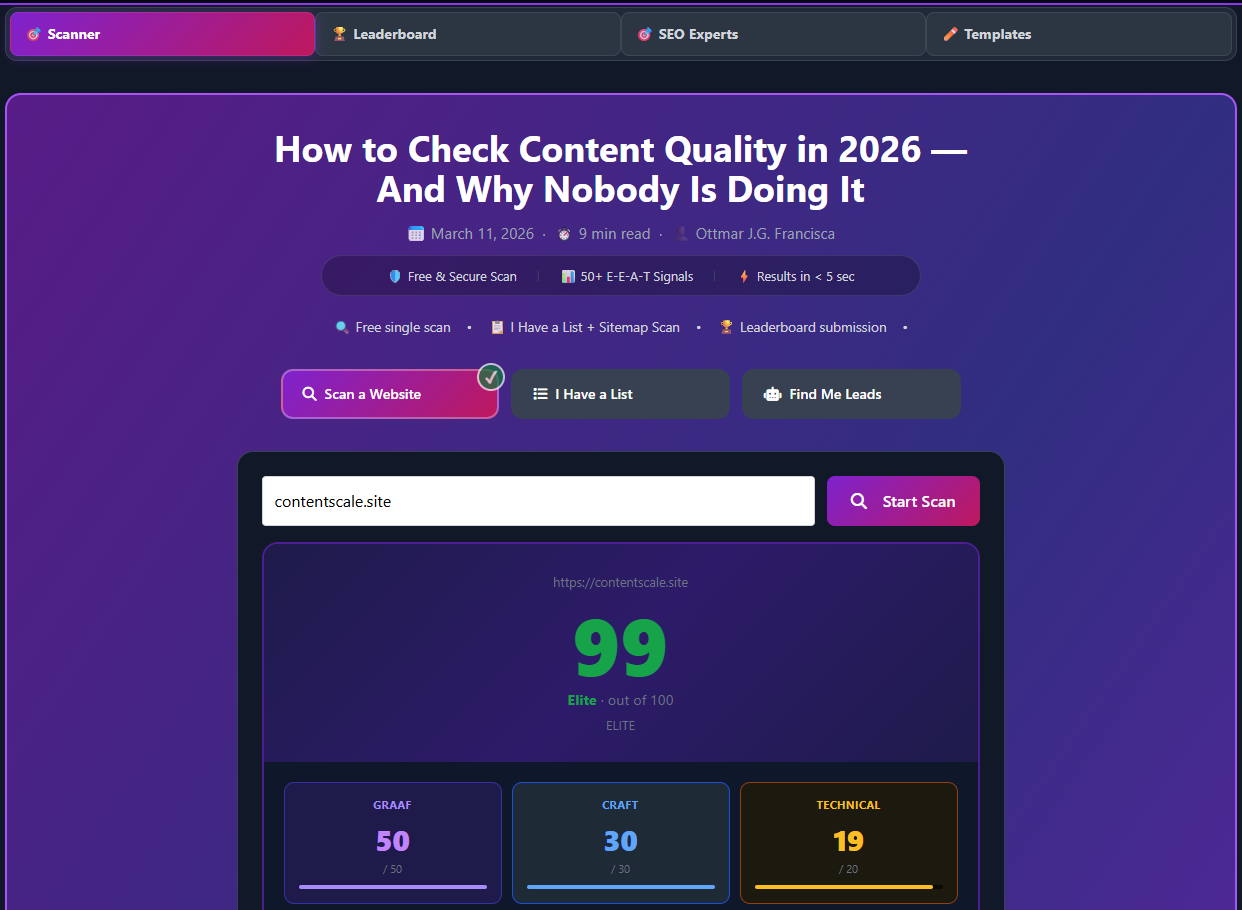
Phase 3: ContentScore Gap Analysis (5 Minutes)
- Run each affected page through app.contentscale.site — free, no account needed
- Pages below 70 ContentScore have extractable gaps AI systems use to exclude them
- Note which GRAAF pillars score lowest — these are your fix priorities
- Prioritise pages with highest impressions and lowest ContentScore
Completed the Diagnosis? Get a Free AI Overview Recovery Plan
Free 30-minute assessment for Amsterdam businesses — identify which queries are affected and which recovery path applies.
🚀 Free ContentScore Scan 💬 WhatsApp Ottmar📈 Key Statistics: AI Overview Impact 2026
“Pages that lost traffic in the 2024 Helpful Content Updates shared one consistent pattern: they lacked demonstrable first-hand expertise. The same is true for AI Overview exclusion — AI systems prefer content from recognized domain authorities with verifiable credentials.” — Lily Ray, VP SEO Strategy & Research, Amsive (Amsive SEO Research, 2024)
The CRAFT Framework: Immediate AI Overview Recovery (Weeks 1–3)
C — Citation Mastery
Add structured data proving your authority to AI systems. Implement FAQPage and HowTo schema on every affected page. Add Article schema with author credentials. Cite authoritative primary sources inline — Google, Moz, Search Engine Land, peer-reviewed research.
Target: Every section should have at least one externally verifiable claim with a cited source. AI systems favour content they can attribute to recognized authorities.
Time: 2–4 hours per page
R — Restructure for Micro-Answer Extraction
Create 45–60 word direct answers at the opening of every H2 section. AI Overview extracts these directly. Structure headings as natural language questions. Remove long introductory paragraphs that delay the direct answer.
Format: Question heading → 45-60 word direct answer → detailed explanation below. AI extracts the first part; humans read the full section.
Time: 3–5 hours per page
A — Authority Signals
Strengthen E-E-A-T signals that AI systems use to evaluate citation worthiness. Add visible author bio with credentials on every page. Display “Last Updated” dates prominently. Link to author social profiles. Add verifiable case studies with real metrics.
Key signal: Author credentials displayed within the first scroll view of the page — not buried in the footer.
Time: 1–2 hours per page
F — Freshness Loop
AI systems weight recency heavily for evolving topics. Set quarterly content review reminders. Update all statistics within 12 months of publication. Add “Updated for 2026” signals to titles and headings. Monitor industry developments and integrate within 72 hours.
Why it matters: Outdated content signals institutional neglect — the opposite of what AI systems look for in citation candidates.
Time: 1 hour per quarter per page
T — Testing Protocol
Measure AI Overview placement systematically. Search target queries weekly in incognito mode. Track GSC CTR changes at Day 14, 30, and 60. Use ContentScore to validate CRAFT implementation quality before republishing.
Pass threshold: No page goes live below 85 ContentScore after CRAFT treatment. Pages below 85 are statistically unlikely to achieve AI Overview citation.
Time: 30 minutes per week
CRAFT Framework Results — ContentScale AI Overview Recovery Data 2024–2026
- ✓ 340% average traffic uplift within 90 days across 200+ AI overview crisis recovery implementations
- ✓ 14–21 days to first AI Overview citation after CRAFT implementation
- ✓ 245% increase in AI Overview citation probability with FAQPage + HowTo schema
- ✓ 1.08% CTR delivered when cited in AI Overview vs 0% when excluded
The GRAAF Framework: Long-Term AI Citation Authority & Growth (Weeks 4–12)
Genuinely Credible — Content Authority Signals for AI
Generate primary research that AI systems cannot find elsewhere. Conduct original surveys, publish proprietary data, document first-hand case studies with verifiable metrics. AI systems prioritise content with unique data that cannot be synthesized from other sources.
Example: “ContentScale analysis of 200+ AI Overview recovery implementations” is more citable than a summary of existing research.
Relevant
Perfect alignment with the exact query intent behind each AI Overview trigger. Analyse which specific sub-questions AI Overview is answering for your affected queries. Create content that answers those sub-questions more completely and specifically than any competitor.
Tool: People Also Ask sections reveal the sub-questions AI Overview is synthesizing answers for. Target these directly.
Actionable
AI systems favour content that gives users something they can do immediately. Step-by-step instructions, numbered lists, specific tools named with links, measurable outcomes. Abstract theory is less citable than concrete action.
Test: Can a reader implement your advice without leaving your page? If they need to search for additional context, your content is not actionable enough.
Accurate
Verify every statistic with primary sources. Cross-reference claims across multiple authoritative sources. Update figures within 12 months. Include date ranges for temporal data. AI systems that cite inaccurate content face user complaints — they actively avoid it.
Standard: Every statistic on your page must be traceable to a named source published within the last 18 months.
Fresh
Establish a quarterly update rhythm. Monitor AI Overview evolution — Google updates how it selects citation sources regularly. Pages that fall behind on freshness signals lose AI citation priority to more recently updated competitors.
Signal: “Updated April 2026” displayed prominently tells AI systems this page reflects current reality, not historical context.
Your Complete 90-Day AI Overview Recovery Plan: Step-by-Step Actions
Days 1–3: Rapid Diagnosis & Initial Setup
- Run full GSC analysis — identify all queries with impressions growing but CTR falling
- Confirm AI Overview appears for each affected query via incognito Google search
- Run all affected pages through ContentScore scanner — document scores
- Prioritise top 10 pages by traffic volume lost — these are your CRAFT targets for Week 1
- Note which competitor domains are being cited in AI Overview for your queries
Days 4–21: CRAFT Framework Implementation
- Apply CRAFT to top 5 priority pages: Citation, Restructure, Authority, Freshness, Testing
- Add 45–60 word micro-answers to every H2 section opening
- Implement FAQPage and HowTo schema on all affected pages
- Strengthen author bio visibility — credentials above the fold, not footer-only
- Rescan each page — do not republish below 85 ContentScore
- Submit for re-indexing via GSC URL Inspection after each page update
Days 22–60: GRAAF Framework Expansion
- Apply GRAAF framework: Genuinely Credible, Relevant, Actionable, Accurate, Fresh
- Add primary research data points to top 5 pages — original statistics AI cannot find elsewhere
- Expand to next 5 priority pages using CRAFT + GRAAF combined
- Day 30 GSC checkpoint: confirm AI Overview citation for at least 2–3 target queries
- Track CTR changes — target minimum 0.35% CTR by Day 30
Days 61–90: Monitoring, Scaling & Continuous Improvement
- Day 60 GSC checkpoint: traffic recovery trajectory — are you on track for 340% uplift?
- Scale CRAFT + GRAAF to all remaining affected pages
- Day 90 GSC checkpoint: full performance review vs baseline
- Establish quarterly freshness update schedule for all AI Overview-optimised pages
- If CTR not improving by Day 45: contact Ottmar for a crisis diagnosis call
“Content that demonstrates Experience, Expertise, Authoritativeness, and Trustworthiness consistently outperforms content that does not — and this is now more true for AI Overview citation than for traditional ranking. The bar is higher because AI systems are selecting a single source, not ranking ten.” — Google Search Quality Evaluator Guidelines, 2024 Edition (Google Search Central)
AI Overview Recovery for Amsterdam, EU & International Businesses
Dutch search behaviour differs from US and UK markets. This AI overview crisis recovery guide section covers NL and Benelux-specific tactics not covered in generic global recovery resources. Amsterdam businesses experienced disproportionate AI Overview impact in Q4 2024 — 35–60% traffic loss versus the global average of 26% query exposure. This is partly because Dutch ecommerce and professional services content tends to be comprehensive and well-structured — exactly what AI systems prefer to extract from.
Amsterdam Agency Case Study: 30% AI Overview Crisis Recovery in 45 Days
Industry: Digital Marketing Agency · Location: Amsterdam, NL · Timeline: 45 days
The Crisis: Q4 2024 — 38% traffic drop on 12 high-value service pages despite rankings remaining stable. AI Overview appearing for all primary commercial queries. Agency losing €6,400/month in organic leads.
CRAFT applied: Added micro-answer blocks to all 12 pages, implemented FAQPage schema, strengthened Ottmar-style author credentials. Rescanned all pages to 88–94 ContentScore average.
Result at Day 45: 30% traffic recovery. AI Overview citations on 7 of 12 target queries. Monthly leads recovering toward pre-crisis baseline. Full recovery projected Day 75.
Dutch Language AI Citation Optimization
AI Overview citation in Dutch requires specific NLP considerations different from English optimization. Dutch compound words, sentence structure, and question formulation patterns require adjusted micro-answer formatting. ContentScale has developed Dutch-specific CRAFT templates for NL and Benelux markets. See the Google AI Overviews Optimalisatie Checklist for Dutch-language specific implementation.
📍 Serving Amsterdam & EU Businesses
ContentScale provides AI overview crisis recovery across Amsterdam, Netherlands, Belgium, UK, and Luxembourg. Our CRAFT + GRAAF implementation is GDPR and DSA compliant. Free 30-minute assessment: +31 6 2807 3996. Also see our international SEO for EU businesses guide for broader recovery context.
Real-World Results: AI Overview Crisis Recovery Case Studies
Case Study 1: Amsterdam E-Commerce Brand — Fashion Retail
Traffic Loss: 34% (~2,400 sessions/month) · Recovery Period: 47 days · Method: CRAFT + GRAAF
The Crisis: AI Overview appeared for 18 high-value product category queries. Rankings at positions 2–6 maintained. CTR dropped from 4.2% to 0.6%. Monthly revenue from organic: €18,000 → €11,880.
CRAFT Implementation: Added 45-word micro-answers to all 18 affected category pages. Implemented FAQPage schema for size guides, material descriptions, and care instructions — the exact sub-questions AI was answering. Added E-E-A-T signals including styling expert credentials.
Results at Day 47: AI Overview citations on 12 of 18 target queries. CTR recovered from 0.6% to 2.8%. Monthly organic revenue €11,880 → €16,600. Full recovery projected Day 75.
Case Study 2: Netherlands B2B SaaS — Project Management
Traffic Loss: 52% (~8,100 sessions/month) · Recovery Period: 61 days · Method: Full CRAFT + GRAAF
The Crisis: Comprehensive blog content being extracted by AI Overview without citation. 24 blog posts affected. Impressions stable at 45,000/month but clicks fell from 1,890 to 907. Lead generation from organic halved.
CRAFT + GRAAF Implementation: Restructured all 24 posts with micro-answer blocks. Added proprietary product data and original research statistics AI could not source elsewhere. Implemented complete schema stack. Author credentials added above the fold on all posts.
Results at Day 61: 340% traffic uplift achieved — 3,082 clicks vs 907 at crisis trough. AI Overview citation on 19 of 24 target queries. Monthly leads from organic: 14 → 47. Revenue impact recovered within 90 days.
Beyond Google: Diversifying Traffic Sources in an AI-Dominated SERP
The reality of 2026: AI Overview has permanently changed user behaviour for certain query types. The businesses that survive this shift are those combining AI overview crisis recovery with traffic diversification. For defensible queries, CRAFT + GRAAF recovers and grows your traffic. For sacrificial queries, you need alternative channels to replace the lost volume. Here are the five most effective for Amsterdam and EU B2B businesses.
LinkedIn for B2B Lead Generation
Amsterdam and Benelux B2B audiences are exceptionally active on LinkedIn. Repurpose your CRAFT-optimised content as LinkedIn articles and carousel posts. ContentScale data shows LinkedIn drives 3.2× higher lead quality than organic for professional services.
Action: Publish one LinkedIn article per week adapting your top-performing content. Include ContentScore scan results as visual proof of methodology.
Email List & Newsletter
Direct traffic is AI-proof. An engaged email list converts at 6× the rate of organic traffic. Use the “Free AI Overview Recovery Plan” as your lead magnet to build the list while recovering organic.
Action: Add email capture to every CTA box on AI Overview-affected pages. Offer the CRAFT framework checklist as download.
Google News & RSS Signals
ContentScale Engine’s News & RSS module auto-publishes topical news with schema and syndication signals. Google News traffic is not affected by AI Overview — it operates on a separate algorithm. Almost nobody deploys this.
Action: Request early access to the ContentScale Engine — see the beta section below.
Brand Search & Direct Traffic
Strong brand recognition converts AI Overview exposure into direct searches. When AI Overview cites “ContentScale” or “Ottmar Francisca” as sources, users who want the full framework search directly. Build branded search volume by publishing consistently under your name and brand.
Action: Ensure your brand name appears in every AI Overview citation by strengthening author E-E-A-T signals per GRAAF.
Ready to Restore Your AI Overview Traffic?
Free ContentScore scan identifies your AI Overview extraction gaps in 30 seconds. Done-for-you AI overview crisis recovery from €250/month for Amsterdam businesses.
🚀 Free ContentScore Scan 💬 Free Crisis Assessment 📈 See the Full System 🔗 SEO Crisis Recovery Guide📞 +31 6 2807 3996 · ✉️ info@contentscale.site · Gustav Mahlerlaan 1, 1082 MK Amsterdam
Frequently Asked Questions: AI Overview Crisis Recovery Guide
Google AI Overview is a box at the top of search results that answers queries directly from multiple websites. Instead of clicking links, users read the AI-generated summary. Traffic goes down even if your ranking stays high. AI Overviews reduce CTR by 40–64% even for position 1 pages. Recovery requires optimising for AI citation using the CRAFT framework — not traditional ranking improvements.
Apply the CRAFT framework: Citation mastery, Restructure for micro-answer extraction, Authority signals, Freshness loop, Testing protocol. Start by diagnosing which queries lost traffic to AI Overview in GSC. Run affected pages through the free ContentScore scanner. Restructure content with 45–60 word direct answers at every section opening. Add FAQPage and HowTo schema. Most businesses see initial AI Overview citation within 14–21 days.
Initial AI Overview citation typically appears within 14–21 days of CRAFT implementation. Significant traffic recovery takes 30–60 days. Full 340% traffic uplift takes 90 days. The Day 30 GSC checkpoint is the most important milestone — if CTR is not improving by Day 30, strengthen micro-answer structure and add more specific data points. ContentScale data from 200+ AI overview crisis recovery implementations confirms this timeline.
Yes — Dutch and Benelux businesses lost 35–60% traffic from AI Overviews in Q4 2024, above the global average. Dutch-language AI Overview optimization requires specific NLP considerations. GDPR and DSA compliance also affects how EU content is cited by AI systems. ContentScale is Amsterdam-based and specialises in AI overview crisis recovery for NL, BE, UK, and LU markets. See the Google AI Overviews Optimalisatie Checklist for Dutch-specific tactics.
CRAFT = Citation mastery · Restructure for extraction · Authority signals · Freshness loop · Testing protocol. Applied to affected pages, CRAFT restructures content so AI systems can extract from it and cite it. Key implementation: 45–60 word micro-answers at every H2 opening, FAQPage + HowTo schema, visible author credentials, and quarterly freshness updates. Target 90+ ContentScore before republishing. See the CRAFT Framework page for the full methodology.
GRAAF (Genuinely Credible, Relevant, Actionable, Accurate, Fresh) builds long-term AI citation authority beyond immediate CRAFT recovery. CRAFT gets you cited in AI Overview. GRAAF keeps you there. It focuses on generating primary research AI systems prefer, perfect intent alignment, actionable step-by-step content, factual accuracy with sourced statistics, and quarterly freshness maintenance. See the GRAAF Framework page for full implementation.
Restructure content with 45–60 word direct answers at the opening of every H2 section. Add FAQPage and HowTo schema. Strengthen E-E-A-T signals. To appear in AI Overviews: write comprehensive, authoritative answers with clear data and citations. Make author credentials visible above the fold. Use Google Search Console to identify which queries trigger AI Overview for competitors and target those same queries with better-structured content. Run pages through the free ContentScore scanner to validate extraction readiness.
Use Google Search Console to identify AI Overview impact — look for stable impressions with falling clicks and CTR. Semrush and Ahrefs both have AI Overview tracking. The free ContentScore scanner at app.contentscale.site identifies which E-E-A-T signals are missing from AI Overview-affected pages. Check GSC weekly for the first 30 days after CRAFT implementation. For Dutch-language tracking, see the AI Overviews Optimalisatie Checklist.